First install compilers and make tools by
sudo apt-get install build-essential
Go to this page and download the driver
Set the execution permission necessarily but I always do like this
sudo chmod 777 NVIDIA-Linux-x86-180.51-pkg1.run
press ctrl+alt+f1 and you should be on the pure terminal. If not press that combination until it works and then stop the xserver
sudo /init.d/gdm stop
Then
./NVIDIA-Linux-x86-180.51-pkg1.run
Accept the agreement and say OK for anything asked. After successful installation
sudo /init.d/gdm start
Monday, May 11, 2009

Saturday, May 9, 2009
Thank God because Mahela is back

Today, Mahela Jayawardana steered the Kings IX Punjab to the victory over Decan Chargers. He scored 43 runs and took two stunning catches hence became the man of the match. I writing this blog post not because I am a support if Kings team but I am very happy because Mahela is back in action and we can hope a lot more to Sri Lanka from this world class stylish right handerd batsman. I never ever consider Mahela as an ordinary batsman but I think he is an intelligent batsmen. Because nobody can predicts from which location the ball is going to cross the boundary when the Mahela in action as a batsman. He is such class and this classic batsman have become one of the most technically sound cricketers in the world today. The most interesting thing I like to see in Mahela's batting is the movement of his feet, He uses that elegantly and play wonderful drives along the ground. But he is not a batsman who has been categorized as off side or leg side batsman because he is strong in both areas. Finnaly I am really anticipated for couple of fine nocks from Mahela Jayawardana soon.
Saturday, May 2, 2009
Let us salute the great nations that genuinely helped us fight terrorism
Sri Lanka is about to conclude her war against terror. The ordeal that about 19 million people have been living with for more than quarter of a century is about to be over. It would never be too early to express our gratitude to all the great nations who genuinely helped us to come this far in this historic battle. Because, the value of a sincere friend would never be so felt, as when one is beset by a group of hypocrites.
On April 30 it was reported that the UN Security Council has no interest in punishing Sri Lanka, by withholding funds that she needs at this moment. Before that decision was taken, some countries that portray themselves as the global guardians of human rights, had made several shameless attempts to recommend punitive action against this poor third world country, struggling to rid itself of terrorism.
Ironically, these so-called human rights champs tried to justify their claims saying that they were doing it for the safety of civilians, held at hostage by terrorists in island's North. Moreover, they put a number of ridiculous demands on the Sri Lanka government, such as offering amnesty to the terrorists, allowing a third party to rescue the terrorist leaders, go for a ceasefire, etc. Never did history unmask the hypocrisy and the sanctimony of the Western Powers than their behaviour towards Sri Lanka during recent times.
In this context, the people of Sri Lanka are grateful for the wholehearted support given to them by India, Pakistan and the rest of the South Asian countries, China, Russia, Pakistan, Japan, Iran, Libya, Vietnam, Mid-East, African and Southeast Asian countries. But for their understanding on our plight and the trust they placed on us, we would never be able to come this far in our battle against terrorism. It seems the international community has become more independent and therefore safer for poor countries like Sri Lanka to stand up for their rights. At least, the people living in poor war affected countries like ours can now have hopes for achieving peace if their leaders are genuine enough to take appropriate action.
It is worthwhile recalling how the civilians, whose safety the Western powers are so worried about, were driven to their current situation. It was the LTTE terrorists who took hold of these civilians at gunpoint and held them as a protective shield during the last three years. As troops gradually liberated the territory held by the LTTE, the terrorists forcibly took most of these civilians with them in order to protect their leaders. All the human rights champions now blaming the government were brazenly silent on this blatant atrocity against our citizens, despite the government's untiring efforts to convince them about the looming humanitarian situation. All they did was trying to corner Sri Lanka in the international community, with their usual "warnings", "urges" "concerns", etc.
They always asked us to stop fighting and start negotiations for a political settlement. Yet, they could not tell us how to stop the continuing atrocities of the LTTE against Sri Lankan citizens. They neglected to see that a political solution is needed for a political problem but not for a terrorist problem.
Human sufferings are the main weapon the LTTE has been using for its survival. It is no secret that the LTTE has been engineering the most brutal crimes against civilians and cunningly manipulates them to its advantage. From their first village massacre in 1984, the terrorists have been mastering this art for earning sympathy for the crimes they themselves committed. The LTTE leadership has been so obsessed with his strategy of cowering among the civilians and increasing their sufferings to win international sympathy.
Therefore, anyone who refuses to accept this realty and asks us to stop fighting against terror, serves the exact purpose of the terror leadership. In other words, it is their response that inspires the terror leadership to continue these crimes. Therefore, all those diplomats, politicians, human rights organizations that dance to the tune of LTTE propaganda are equally responsible of the plight of the civilians under the clutches of terror.
Let us salute our friends who accepted the truth and are bold enough to stand by us at our moment of need.
Original Article is here
On April 30 it was reported that the UN Security Council has no interest in punishing Sri Lanka, by withholding funds that she needs at this moment. Before that decision was taken, some countries that portray themselves as the global guardians of human rights, had made several shameless attempts to recommend punitive action against this poor third world country, struggling to rid itself of terrorism.
Ironically, these so-called human rights champs tried to justify their claims saying that they were doing it for the safety of civilians, held at hostage by terrorists in island's North. Moreover, they put a number of ridiculous demands on the Sri Lanka government, such as offering amnesty to the terrorists, allowing a third party to rescue the terrorist leaders, go for a ceasefire, etc. Never did history unmask the hypocrisy and the sanctimony of the Western Powers than their behaviour towards Sri Lanka during recent times.
In this context, the people of Sri Lanka are grateful for the wholehearted support given to them by India, Pakistan and the rest of the South Asian countries, China, Russia, Pakistan, Japan, Iran, Libya, Vietnam, Mid-East, African and Southeast Asian countries. But for their understanding on our plight and the trust they placed on us, we would never be able to come this far in our battle against terrorism. It seems the international community has become more independent and therefore safer for poor countries like Sri Lanka to stand up for their rights. At least, the people living in poor war affected countries like ours can now have hopes for achieving peace if their leaders are genuine enough to take appropriate action.
It is worthwhile recalling how the civilians, whose safety the Western powers are so worried about, were driven to their current situation. It was the LTTE terrorists who took hold of these civilians at gunpoint and held them as a protective shield during the last three years. As troops gradually liberated the territory held by the LTTE, the terrorists forcibly took most of these civilians with them in order to protect their leaders. All the human rights champions now blaming the government were brazenly silent on this blatant atrocity against our citizens, despite the government's untiring efforts to convince them about the looming humanitarian situation. All they did was trying to corner Sri Lanka in the international community, with their usual "warnings", "urges" "concerns", etc.
They always asked us to stop fighting and start negotiations for a political settlement. Yet, they could not tell us how to stop the continuing atrocities of the LTTE against Sri Lankan citizens. They neglected to see that a political solution is needed for a political problem but not for a terrorist problem.
Human sufferings are the main weapon the LTTE has been using for its survival. It is no secret that the LTTE has been engineering the most brutal crimes against civilians and cunningly manipulates them to its advantage. From their first village massacre in 1984, the terrorists have been mastering this art for earning sympathy for the crimes they themselves committed. The LTTE leadership has been so obsessed with his strategy of cowering among the civilians and increasing their sufferings to win international sympathy.
Therefore, anyone who refuses to accept this realty and asks us to stop fighting against terror, serves the exact purpose of the terror leadership. In other words, it is their response that inspires the terror leadership to continue these crimes. Therefore, all those diplomats, politicians, human rights organizations that dance to the tune of LTTE propaganda are equally responsible of the plight of the civilians under the clutches of terror.
Let us salute our friends who accepted the truth and are bold enough to stand by us at our moment of need.
Original Article is here
Wednesday, April 29, 2009
Sanga showed off some character
 It was the match between Mumbai Indians and Kings Eleven Punjab. Kings batted first and scored 119 in a pitch where ballers are supposed to rock. The Kings wicket keeper batsman Kumar Sangakkara scored unbeaten 45 while others collapsing for low scores. MI started chase but the veteran opening pair returned to the MI dug out early and others also had the same fate. But J.P. Dumminy and Abishake Nayar fought back but Nayar fell as the MI had to get 30 out of 26 balls. In the next over, Kings captain Yuvraj Sing injured while he try to stop a boundary and Kings seems to plying without a captain for a while. On that moment, the new Sri Lankan captain and Kings wicket keeper Kumar Sangakkara took reign of the Kings team as the MI had to score 20 out of 12 balls. Sanga with the help of his former captain and his friend Mahela set the field and gave the ball to Abdulla to ball the critical 19th over. But suddenly Sanga took ball from Abdulla and gave it to Chawla and Chawla produced the goods in the first ball. Finally, MI were restricted to 117 and it was Sangakkara who became the man of the match for the second time in IPL 2009.
Tuesday, April 21, 2009
World lagest hostage rescue mission is on-35 thousand rescued in first day.
This is not my post by defence wire one of the famous blog
first
second
third
fourth
This is from wannioperation.com
fifth
From Nations.lk
Lakbima News
first
second
third
fourth
This is from wannioperation.com
fifth
From Nations.lk
Lakbima News
Thursday, April 16, 2009
Saturday, April 11, 2009
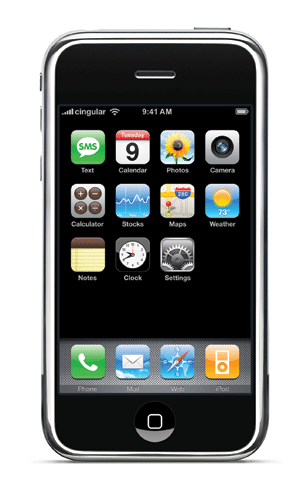
Android VS Iphone
This is a nice conversation still going on in Android mailing list. I have put the offensive stuff brought forward by A.I. Sutton. That is not because I hate Android but there are people who love Iphone. In my case I need both.

Now before I start on the iPhone comparison I'm going to pre-empt the normal "But Android is open source....." response by saying lets be honest and admit it as it stands Android is not an open source project because the public "open source" repository is pretty worthless in its' current state.
The last time I tried to build the master branch it failed missing some Google internal API classes. The SDKs I've produce from the cupcake branch seem to be considered by Google employees as pretty useless with comments like "This is why we want to be clear it is "unofficial," because it is not actually a working SDK" being thrown around and networking in the emulator
still being broken a week after users started reporting the showstopper problem (And Romain did hint that Google have a fix, I read http://groups.google.com/group/android-developers/msg/41fcefc36bd16d44 as "there is a version where this is fixed"). And as we all know you can't use it to build the exact versions of the open source parts of either of the two firmware versions that have shipped on the G1.
To me it seems little more than code dump which is aimed at ensuring Google can keep saying "But it is open source and not just a Google project"
Now, in the last week I had few conversations with iPhone developers so I could compare the Android developer experience to that of what is perceived as our nearest competitor and they are laughing at us (seriously, when I mentioned the G1 most of them responded by initially chuckling). The general consensus among them was;
Now, in the last week I had few conversations with iPhone developers so I could compare the Android developer experience to that of what is perceived as our nearest competitor and they are laughing at us (seriously, when I mentioned the G1 most of them responded by initially chuckling). The general consensus among them was;
- Yes, you pay $99 for the iPhone dev kit, but you get "free" external testing (i.e. at apple) and commercial quality support with many queries being turned around in hours or a couple of days at worst. Compare that to some of the support queries on b.android.com for basic problems things like a Android failing to connect to wireless lans with hidden SSID (http://code.google.com/p/android/issues/detail?id=1041) which, after *five and a half months* is still marked as "New" and doesn't have a single response from a Google employee.
- The most common cause of App Store listing rejections are things that users would complain about anyway. This includes things like performance characteristics, UI anomalies, and inconsistent behaviour. This is the type of stuff that is left for users to find out on Android and only comes to light when 1* or 2* comments are posted and even then you don't know if it's
a one off on the users device or possibly something specific to their region (http://code.google.com/p/android/issues/detail?id=2372).
a one off on the users device or possibly something specific to their region (http://code.google.com/p/android/issues/detail?id=2372).
- The normal amount of time from submission to app store listing is around 7 days. Some apps take months to go through the approval process, but that is because of intellectual property concerns, concerns over offensive content, or is because the app has to be re-reviewed a few times to meet the apples performance and behaviour guidelines. Yes it's not as fast as Android, but you know that once it's on the market it's of a quality where you're not going to get bombarded with user queries about problems straight off.
- Most of the developers actually feel valued by Apple and feel that Apple does what it can to make sure they get the tools they need to do their job and ensure they're apps. This has been re-enforced by allowing the developers to beta test the new firmware and develop against it.
Personally, it's made me shell out $99 for an iPhone SDK, dust off my Nokia N81, and spend $75 on eBay on a Blackberry so I can explore the alternatives.
This is a reply to that by Tom Gibara
I think my response might best have been posted to android-discuss, but I'll reply here anyway.
Pre-empting a debate about whether Android is open source with the argument "...let's be honest..." isn't adequate. I don't know whether there are established metrics for measuring a degree to which a project rates as being "open source", but here are some of mine:
I think my response might best have been posted to android-discuss, but I'll reply here anyway.
Pre-empting a debate about whether Android is open source with the argument "...let's be honest..." isn't adequate. I don't know whether there are established metrics for measuring a degree to which a project rates as being "open source", but here are some of mine:
(1) Can I make use of the code and do so freely?
(2) Can I distribute the code free of onerous conditions?
(3) Can I contribute?
(4) Can I be openly critical?
By all of these metrics I regard Android as open source.
(1) I regularly access the git repository to learn how various Android components work. I downloaded and successfully built an SDK based on cupcake for a preview of forthcoming IMF. On a few private scratch projects, I've copied widget code out of the android framework and tweaked it to make my own UI components. I neither sought nor needed permission from Google to do any of these things because the code was licensed so as to give me these freedoms.
(1) I regularly access the git repository to learn how various Android components work. I downloaded and successfully built an SDK based on cupcake for a preview of forthcoming IMF. On a few private scratch projects, I've copied widget code out of the android framework and tweaked it to make my own UI components. I neither sought nor needed permission from Google to do any of these things because the code was licensed so as to give me these freedoms.
(2) Since almost all of the source code is licensed under the Apache License I feel very comfortable distributing any software I derive from it since it's an extremely permissive and well understood license. I've seen a number of people post in this, and other groups, that the absence of some code from the repository disqualifies Android from being open source; even that the inability to create an installable phone image betrays a malign intent. I don't hold with these arguments - they would carry weight if Android was only operable on one model/brand of hardware but since that's demonstrably not the case I'm contemptuous of them.
(3) I have to-date made one very modest contribution to the Android code base, but intend to make more when time permits. My limited experience so far is that the Android engineers are extremely receptive to contributions pitched at a technical level and supportive of anyone trying to commit code. Perhaps others have had a different experience. I do anticipate that programmers who think they are going to sweep in and carve out whole new areas of functionality inside the core frameworks will probably be disappointed, but due to an inadequate understanding of how large projects need to operate rather than by intransigent Google staff.
(4) This is an important freedom that is not necessarily guaranteed by the preceding ones. I include a public bug reporting system as an element of this. Android has one and there is little evidence that Google engineers ignore the bugs filed there. It's clear that there is insufficient public visibility of the statuses of issues, but that's not the same thing. Reading the android related groups demonstrates that criticisms of Android, irrespective of how well founded they may be, are freely accommodated even though the groups are moderated by Google employees.
Given the personal observations above, I find the argument that Android is not an open source project simply misguided. Perhaps it arises in many instances from a lack of experience with open-source or alternatively large scale software development. I'm not denying that there are some key problems, especially concerning the state of the master branch. Nevertheless, having closely observed the progress of the android project since its first public announcement I believe that things have improved considerably and that they will continue to improve; both the core Android team and the community (as with your interim builds) will have a role to play
I'm not qualified to comment on the experience of releasing iPhone applications, and I'm inclined to believe what you report - that the experience of most iPhone developers is not as negative as many websites like to report. For companies and individuals who are looking to generate more revenue more quickly that they might with an Android application, I would do nothing to dissuade them from investigating other opportunities; the iPhone foremost.
Nevertheless, I regard it as almost inevitable that those with power will ultimately abuse it. As a consequence I believe that Apple will ultimately abuse their monopoly of the App Store. In contrast, I expect the open source nature of Android to protect its community of users from egregious abuses that could be countenanced by present or future management of Google or the OHA.
I regard the ceding of software to its related community via the process of "open sourcing" it as analogous to the establishment of a democracy which forces the government to be reasonable with those governed and thus protects against the worst excesses of its corruption. Companies that open source the software they produce are serving their users by protecting them against the potential actions of future management. Given the significant commitment that I must make to any new platform I adopt, I regard this as any extremely beneficial provision.
Here is again Sutton
My metric is simple; Can I build a working system from the public repository which represents what most users are using?, and the answer to that is currently no.
To me there are many products being labelled Android; There are the ones that are used on devices, there are the ports that people have made to new platforms, and there is the public repository, and although all these are different in their own way people seem to pick attributes from each and say that's what Android is.
My metric is simple; Can I build a working system from the public repository which represents what most users are using?, and the answer to that is currently no.
To me there are many products being labelled Android; There are the ones that are used on devices, there are the ports that people have made to new platforms, and there is the public repository, and although all these are different in their own way people seem to pick attributes from each and say that's what Android is.
As I see things, the answers to your metrics are;
(1) You can for the Android open source project, but not for the version of Android that's shipped on the G1, Magic, or ADP1. I will happily admit I am wrong if someone can give me the git revision numbers from the open source project which will build all the open source components of the "official" updates for these platforms.
(1) You can for the Android open source project, but not for the version of Android that's shipped on the G1, Magic, or ADP1. I will happily admit I am wrong if someone can give me the git revision numbers from the open source project which will build all the open source components of the "official" updates for these platforms.
(2) Again, yes for the open source repo, but again builds from the open
source repo are not what's in use by a majority of Android users.
(3) I've contributed code to "closed source" products before after the source code was made available to me under an NDA. I did not work for the company at the time and I did not get paid for the contribution, so I'm not sure it's a metric of an open source project. I've also had contributions to projects considered as open source sit in a review tree for 6 months and
then one another developer submit the same code and it gets integrated (this was a 1 line fix, and so the fix was *exactly* the same). Therefore I'd say this metric possibly isn't a charactistic that identifies an open source product
source repo are not what's in use by a majority of Android users.
(3) I've contributed code to "closed source" products before after the source code was made available to me under an NDA. I did not work for the company at the time and I did not get paid for the contribution, so I'm not sure it's a metric of an open source project. I've also had contributions to projects considered as open source sit in a review tree for 6 months and
then one another developer submit the same code and it gets integrated (this was a 1 line fix, and so the fix was *exactly* the same). Therefore I'd say this metric possibly isn't a charactistic that identifies an open source product
(4) I would again disagree that bugs are ignored, as I stated in my original email there are bugs that are still marked as new after five and a half months. This means they haven't even reached the "reviewed" stage even though many later bugs have. I would also disagree it's a metric of an open source product as there are numerous public criticisms of Windows, and the
developers complaining over problems submitting iPhone apps are well publicised, and both of these are closed source projects.
developers complaining over problems submitting iPhone apps are well publicised, and both of these are closed source projects.
I think the main point of our differences is that you see Android as one thing, whereas I see Android as the basis for many things which are trading off a brand, and to me that's like saying IBMs HTTPD is open source because it has a codebase built on Apache (Thanks to Disconnect in
href="http://andblogs.net/2009/04/android-and-open-source/ for bringing the
IBM/Apache link up).
href="http://andblogs.net/2009/04/android-and-open-source/ for bringing the
IBM/Apache link up).
Subscribe to:
Posts (Atom)